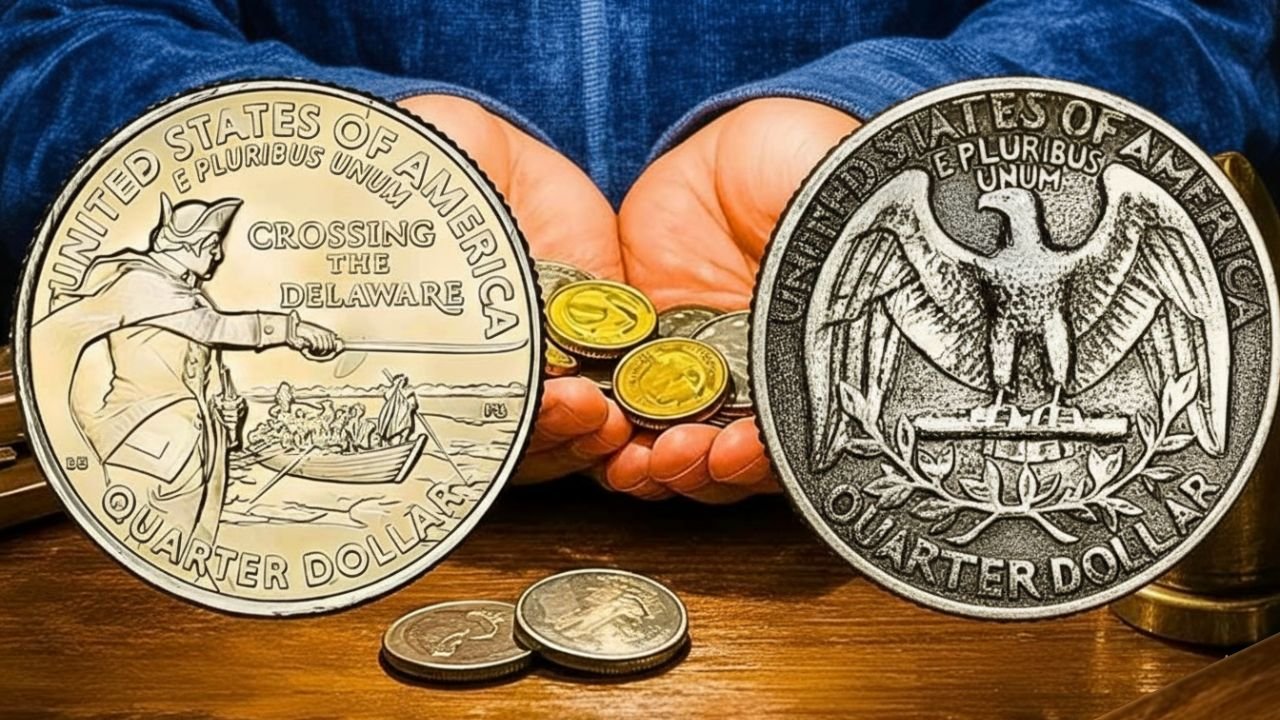
Hidden U.S. Coin Treasures: Since their debut in 1932, Washington Quarters have woven themselves into the fabric of American daily life and collecting passion. Struck to commemorate the 200th anniversary of George Washington’s birth, these coins transitioned from a commemorative issue to a circulating staple. While most are indeed worth just twenty-five cents, a fascinating subset has achieved legendary status in the numismatic world, with rare examples commanding prices that reach into the millions at auction. This journey from pocket change to prized artifact speaks to the powerful combination of history, scarcity, and human fascination.
Historical Significance and Design Evolution
The Washington Quarter was born during the Great Depression, a period when symbols of national stability and founding ideals were deeply needed. Sculptor John Flanagan’s dignified portrait of the first president on the obverse, paired initially with a heraldic eagle on the reverse, provided that symbol. For over three decades, the coin was minted in 90% silver, adding intrinsic value to its face value. The 1965 shift to a copper-nickel clad composition marked a pragmatic response to rising silver prices. The series saw a monumental public resurgence with the launch of the 50 State Quarters program in 1999, which rekindled widespread interest in coin collecting by celebrating national heritage on the reverse design.
A Guide to Washington Quarter Values
The table below provides a general overview of potential values for some notable quarters across different grades. It is crucial to remember that these are approximate market ranges, and final auction prices can vary widely based on exact condition, eye appeal, and current demand.
| Coin Issue | Good-Very Good | Extremely Fine-About Uncirculated | Mint State (MS63-MS65) | Proof/High Grade Rarity |
|---|---|---|---|---|
| 1932-D | $150 – $400 | $1,000 – $4,000 | $10,000 – $40,000+ | $100,000+ (MS66+) |
| 1932-S | $100 – $300 | $800 – $3,000 | $8,000 – $35,000+ | $80,000+ (MS66+) |
| 1943-S Doubled Die Obverse | $500 – $1,500 | $2,500 – $6,000 | $10,000 – $25,000+ | Varies by condition |
| 1950-D/S Overmintmark | $200 – $600 | $1,500 – $4,000 | $5,000 – $15,000+ | Varies by condition |
| 1964-D Doubled Die Reverse | $200 – $800 | $1,000 – $3,000 | $4,000 – $12,000+ | Varies by condition |
| Common Silver Quarter (Pre-1965) | $4 – $6 (Silver Melt) | $8 – $12 | $15 – $50 | N/A |
| Common Clad Quarter (1965-Present) | Face Value | Face Value | $1 – $5 | N/A |
Key Dates and Remarkable Varieties
Certain Washington Quarters are celebrated as “key dates” due to exceptionally low mintages or distinctive errors. These coins are the cornerstones of advanced collections.
The 1932-D and 1932-S quarters are the undisputed kings of the series. As first-year issues from the Denver and San Francisco mints, their mintages were intentionally limited, making any surviving example highly desirable. In pristine, mint-state condition, these coins can fetch prices in the tens of thousands of dollars, setting a high bar for the series.
Error coins hold a special allure for their uniqueness. The 1943-S Doubled Die Obverse exhibits noticeable doubling in the lettering, a result of a misaligned die during production. Similarly, the 1950-D/S Overmintmark shows a “D” mintmark punched over an underlying “S,” a clear mistake that now translates to significant value. Even modern issues can be rare, as seen with the 1964-D Doubled Die Reverse, one of the last silver quarters ever struck, where doubling is apparent on the eagle side.
The Pinnacle of Value Legendary Rarities
While the key dates are rare, the most extreme valuations are reserved for coins that represent the pinnacle of condition, rarity, and provenance. This includes flawless, top-tier examples of the 1932 issues, unique prototype patterns, or spectacular error coins that survived the mint’s quality control. It is these nearly perfect or one-of-a-kind specimens that have achieved valuations in the millions of dollars at prestigious auctions, capturing headlines and inspiring both seasoned collectors and the public to look closer at the coins in their possession.
The Heart of Collecting More Than Money
The pursuit of Washington Quarters transcends financial investment. It is a tactile connection to American history—a 1932 quarter was held by someone during the Depression, a 1943 coin was in circulation during World War II. Collecting fosters patience, research skills, and a community of shared interest. The genuine thrill lies in the hunt: the possibility, however small, of discovering a numismatic treasure in an old jar, a family collection, or even daily change. This sense of discovery and connection is the true, enduring value of the hobby.
Frequently Asked Questions (FAQ)
Q: How can I tell if my Washington Quarter is silver?
A: Quarters minted in 1964 and earlier are 90% silver. You can also check the edge; a silver quarter will have a solid silver stripe, while a clad (post-1964) quarter will show a copper-brown stripe sandwiched between two silver-colored layers.
Q: What is the most valuable Washington Quarter ever sold?
A: While private sale prices are often undisclosed, superb-grade examples of the 1932-D and 1932-S have sold at public auction for well over $100,000. The theoretical multi-million dollar valuations typically refer to unique patterns or the absolute finest-known specimens of key dates.
Q: Where is the mint mark on a Washington Quarter?
A: On quarters minted from 1932 to 1964 and on modern commemoratives, the mint mark (“D” for Denver, “S” for San Francisco, “P” for Philadelphia) is found on the reverse (eagle side), just below the center near the wreath. Philadelphia mint coins before 1980 often had no mint mark.
Q: Should I clean my old coins to increase their value?
A: Absolutely not. Cleaning a coin, even with gentle intentions, almost always damages its surface and reduces its value to collectors. The natural toning and patina are part of a coin’s history. If you believe you have a valuable coin, handle it by the edges and store it in a protective holder.
Q: How do I get a coin professionally graded?
A: Professional grading services like PCGS or NGC provide authentication, grading, and encapsulation. You can typically submit coins through an authorized dealer or directly via the grading company’s website for a fee, which depends on the coin’s value and the service speed desired.
Q: Are the state quarters from 1999-2008 valuable?
A: Most circulated state quarters are worth face value. However, uncirculated rolls, proof sets, and silver proof sets from the series carry a premium. Errors, such as missing clad layers or off-center strikes, can also be valuable to error collectors.